
Identify Who Owns Smith County Property
The fastest route runs through the Smith County Property Link. Its public form accepts a street number and street name. It also takes an owner name, parcel number, PPIN, or section, township, and range. It is a starting gate, not proof of title. One catch exists. The detailed parcel card sits behind a subscription. Anyone blocked at that point can take the same address to the Tax Assessor/Collector.
- Enter the situs address in Property Link and copy the parcel number or PPIN exactly.
- Read the assessment owner name if the subscribed result is available, or ask the assessor to identify the name on the current roll.
- Search that name as grantee in the Deeds & Records Link, then match the legal description to the parcel.
- Use the newest relevant deed as the confirmation point and request its image or a certified copy from the Chancery Clerk.
The owner of record is not the occupant. Nor is it whoever receives the tax mail. This flow keeps those roles apart, and it leaves a clear trail when a rural tract lacks a dependable street address.
Smith County Property Link Starts the Owner Check
Smith County land does not always fit an address-only search. Property Link offers several keys for that reason. Rural tracts often need section, township, and range instead. PPIN and Parcel Number are separate fields, and neither should be reformatted from memory. Owner searches want names entered last-name-first, since spelling and initials matter.
| Search key | Best use | Watch for |
|---|---|---|
| Number and street | Known physical location | Mailing city may differ from situs |
| Owner name | Known person or entity | Use surname first and test variants |
| Parcel Number or PPIN | Exact roll identity | These are distinct portal fields |
| Section, township, range | Rural land | Copy direction choices carefully |
The county states that the assessor maintains current ownership maps, but it does not publish a county-operated interactive GIS viewer. Call the Tax Assessor/Collector at 601-782-9803 when the portal does not resolve a parcel.
See the actual public search form in the Delta Property Link source.
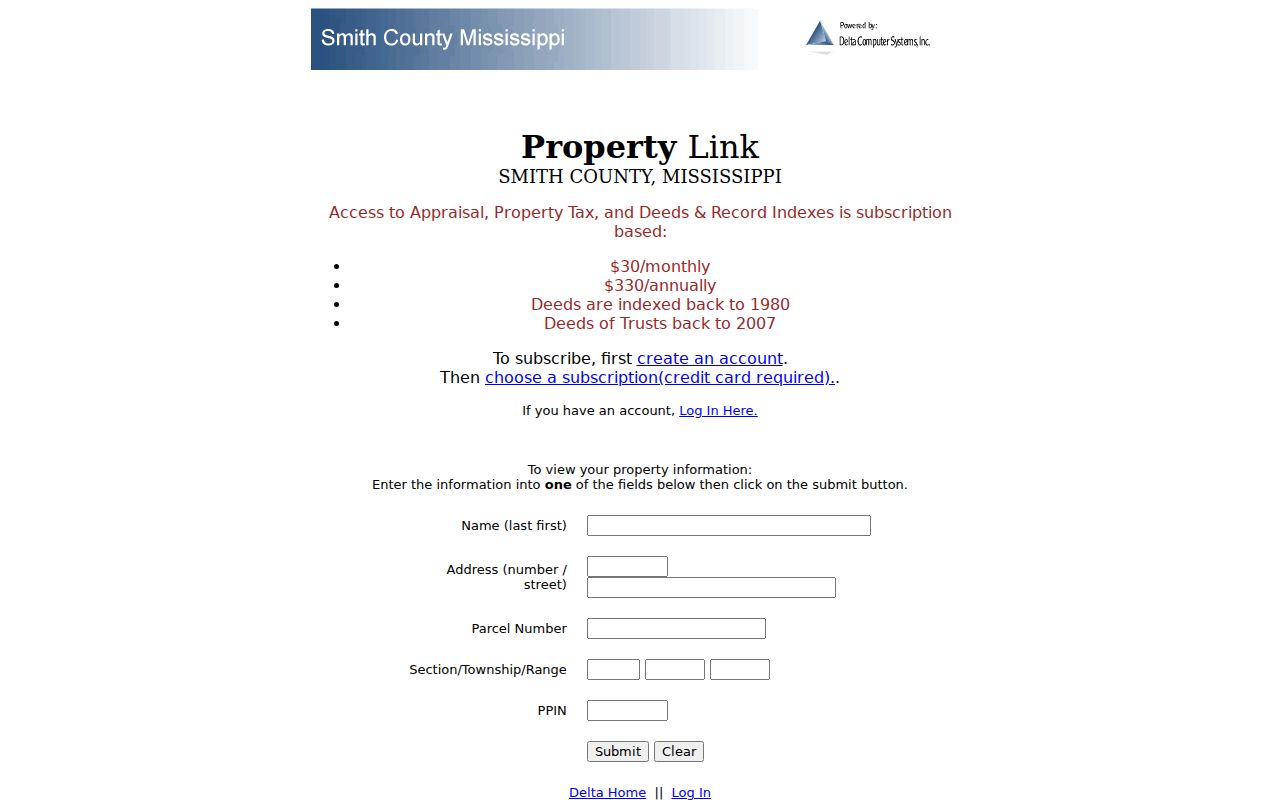
The form displays the multiple search paths plainly. No sample owner card appears without a subscription.
Three Smith County Records Name an Owner
No single screen does every job. The annual land roll supports taxation. The recorded deed documents a conveyance, and the assessor ownership map ties the tax parcel to a place. Reading all three together beats treating a mailing label as a title conclusion.
| Where ownership appears | What it contributes | How current |
|---|---|---|
| Assessor land roll | Assessed owner and parcel key | Current roll, subject to posting lag |
| Chancery deed index | Grantor, grantee, filing reference, legal land | Newest recorded instrument is the key check |
| Assessor ownership map | Parcel location and adjoining parcel context | Ask the office for current map status |
The handoff is the point here. Find the assessed name on the roll, then confirm the conveyance; a fuller reading of the roll's current-owner field belongs on the Smith County current owner page.
Confirm Who Owns Smith County Land in the Deed Index
Deed confirmation runs through the Deeds & Records Link, which accepts grantor or grantee, partial names, book and page, filing date, legal land description, subdivision, block, lot, instrument number, and ranges. Search the roll name as grantee. Compare the returned legal description with the subject parcel. A shared name is not enough. The image below shows the official vendor form used for this step.
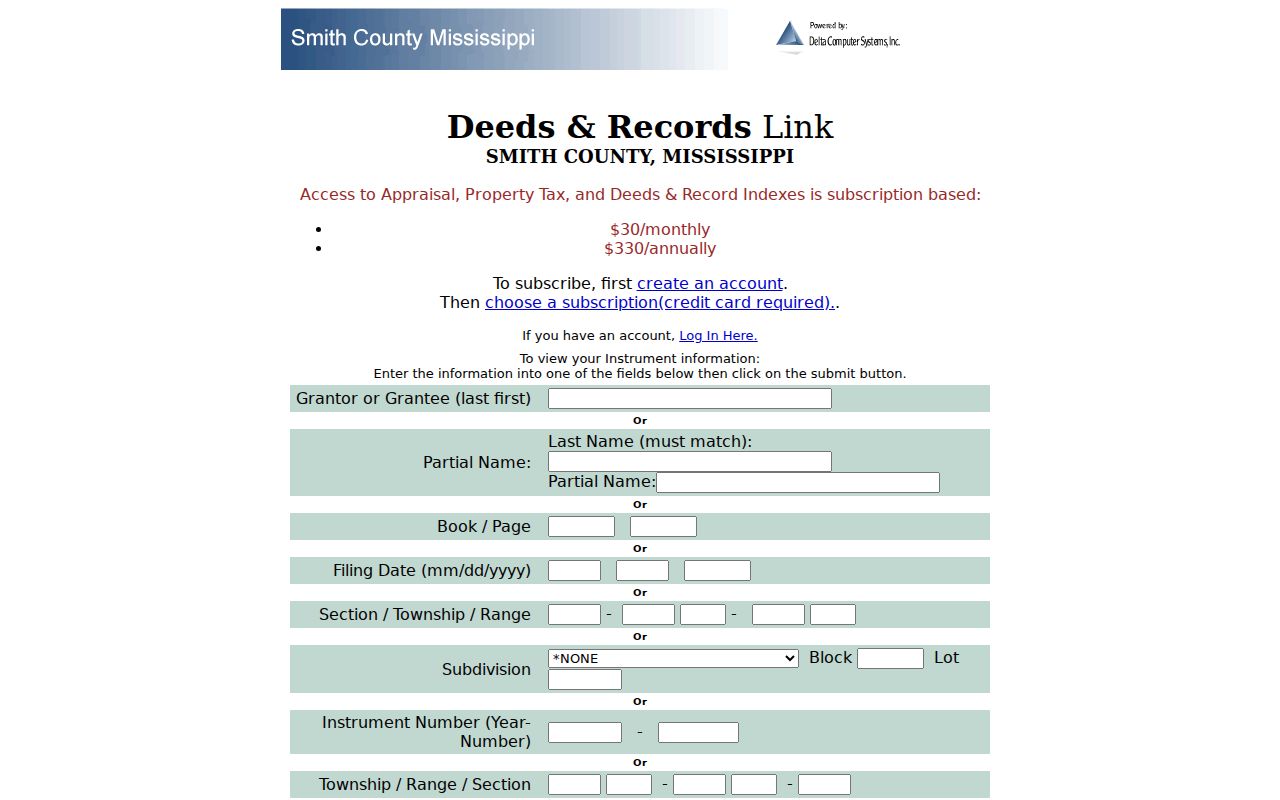
The range and legal-description controls shine when one name matches several people, estates, or business entities. Online deed indexing reaches back to 1980. Deeds of trust go back to 2007. That coverage describes the vendor index, not the age of Smith County's courthouse land books.
Smith County Property Owner Terms That Matter
Small distinctions matter. When the name, address, and legal record refuse to line up, those details keep an owner search on track.
- Owner of record
- The party shown by the current official record being consulted, often the assessment roll for a first check.
- Grantee
- The party receiving the interest in a recorded conveyance.
- Situs address
- The physical property location, which can differ from the owner's mailing address.
- Title
- The legal ownership interest. A portal name is evidence to investigate, not a professional title opinion.
Copy trust, estate, and business wording exactly. Dropping “Estate of,” “Trustee,” or a company suffix can steer a deed-index search toward the wrong party.
When a Smith County Property Owner Is an Entity
An entity may hold the land instead. A deed or roll can name an LLC, corporation, trust, or estate rather than an individual. For a company, compare organization and individual records at the Mississippi Secretary of State Business Services portal. A business filing can identify an official contact or registered agent. It still does not replace the land deed.
Trusts and estates need a different check. Preserve the exact fiduciary wording. Search the Chancery Clerk's deed and estate records. Probate material can explain an ownership change that never passed through an ordinary market sale.
Note: An entity contact helps route a property question, but the matched legal description and latest deed remain the ownership check.
Smith County Owner Research Beyond the Web
Online access to appraisal, property-tax, and deed-index records is subscription based. The rate is $30 monthly or $330 annually. The counter is free. Walk-in land records are open at the Chancery Clerk from 8 a.m. to 5 p.m. on weekdays, at the new Chancery Building across from the historic courthouse at 201 Courthouse Square in Raleigh.
Mail works too. Send requests to the Smith County Chancery Clerk, P.O. Box 39, Raleigh, MS 39153. Identify the record by parties, book and page, instrument number, or legal description. Enclose a check or money order. Add a stamped self-addressed envelope. Copies run 25 cents per page when the public makes them, 50 cents when staff does, and certification costs extra.
The Mississippi Public Records Act offers a final path to an existing, nonexempt record that routine service does not supply. Ask for one named roll, map, or index entry. A precise request works far better than open-ended research.
A Recent Smith County Sale Can Outrun the Roll
Deeds and assessment rolls run on different clocks in Smith County. A deed often reaches the recorder first. The assessor's ownership data can lag behind it for a while. So an old name on the roll does not mean the sale fell through. If the name has not updated after a known closing, search the deed index by recording date and new grantee. You can also call the Chancery Clerk at 601-782-9811.
Recent-sale check. The roll can lag a conveyance. For a current answer, compare it with the newest recorded deed that matches the land.
That same lag explains why a tax bill sometimes still mails to a prior address. Treat it as a posting detail to confirm, not evidence that the closing failed.
Smith County Owner Trails Before the Online Cutoff
Owner questions in Smith County often grow into heir, estate, or house-history projects. The trail may reach before 1980. At that point, the Chancery Clerk's direct and reverse indexes, deed books, and plat cabinets carry it. The Mississippi Department of Archives and History genealogy guidance covers both courthouse originals and state microfilm. The two can complement one another. Treat that as an access fallback rather than a former-owner walkthrough. Older Smith County material includes MDAH finding aids for original records. Those span 1832 through 1966. Digitized assessment material begins in 1834. Exact record years vary by series. Note: Follow the same legal description across old books, since street names and municipal labels may change while the land stays fixed.
Limits on a Smith County Ownership Lookup
An assessor name alone does not prove occupancy. A deed-index hit does not settle every title questions. Unrecorded interests, life estates, probate orders, liens, releases, boundary disputes, and later corrective instruments can all reshape the legal picture. Certified instruments must come from the custodian, and a formal title opinion from qualified professional work. For buyers, public owner information works well. The same goes for boundary questions, estate researchers, and anyone with a legitimate reason to reach a landowner. Use the tax-roll mailing address only for a genuine property matter. Respect protected-address and sealed-record limits.
Lawful use. A Smith County property owner lookup is not permission to track, threaten, or harass anyone. Stop if the inquiry crosses that line.