
Read the Smith County Owner-of-Record Card
The Smith County Tax Assessor locates, classifies, and values taxable property each year. It also maintains the current ownership maps. Its land roll is the practical first record for a current-owner check. The public Delta Property Link exposes the search keys. The detail card itself sits behind a subscription. So treat any field the assessor normally publishes as a claim to confirm, not a fact already in hand.
| Owner name | Confirm the exact current roll label with the portal result or assessor. |
|---|---|
| Mailing address | Where tax notices may be sent; public display was not verified. |
| Situs | The land's physical address, separate from owner mail. |
| Parcel Number and PPIN | Distinct exposed keys connecting the roll to the land. |
| Last sale and deed reference | Not visible publicly; confirm in the deed index. |
The owner-of-record card pulls the current roll clues together in one view, while the latest recorded deed supplies the stronger transfer check on who now holds the parcel.
Smith County Current Owner Search Fields
Both Property Link and Property Appraisal accept an owner name, street address, parcel number, or PPIN. Property Link adds section, township, and range as search keys. Enter names last-name-first, since initials and spelling variants often hide the result you want.
| Field | Present-owner use | Limit |
|---|---|---|
| Name | Find parcels under roll wording | Keep trust, estate, and company names intact |
| Address | Start from a known situs | Postal and situs labels can differ |
| Parcel Number | Pin the check to one tax parcel | Exact format is not stated publicly |
| PPIN | Use the alternate system identifier | Do not substitute it for parcel number |
The Property Appraisal source shows these entry fields and the subscription notice.
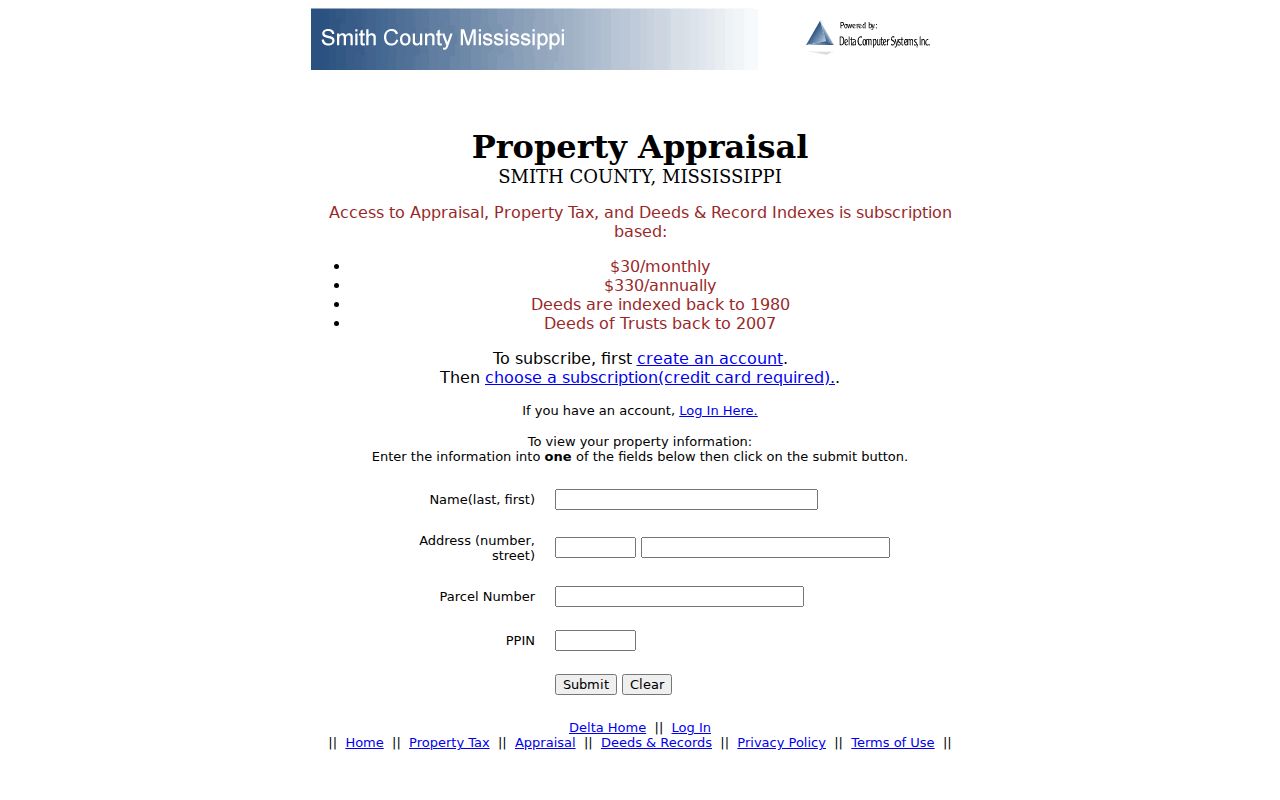
Those are the search modes the tools support. Owner, mailing, sale, value, and deed-detail fields still require an authenticated result or a check at the office.
How Current the Smith County Owner Roll Is
Online roll data can lag behind the courthouse. A deed may already be recorded while the assessor's current-owner field still carries the prior name. Smith County publishes no standard update window, so assume no fixed lag.
Recent conveyance. When the roll and a reported sale conflict, the newest recorded deed matching the legal description is the more current ownership record.
Ask the assessor which roll date the screen displays. Then ask the Chancery Clerk whether a later deed has posted. That paired check beats guessing from any vendor screen.
Confirm the Current Smith County Owner
Current ownership is confirmed by connecting one assessment parcel to one recent conveyance. The general method appears on the Smith County property owner page. This check focuses on the record as it stands now.
- Search the address and copy parcel number, PPIN, and exact assessed-owner wording.
- Open the Deeds & Records Link and search that owner as grantee.
- Compare filing date, instrument reference, and legal description.
- Request the matching deed when an official copy is needed.
The deed portal also takes partial names, date ranges, subdivision, block, lot, and section, township, and range. Those refinements separate similar names from one another.
Current Owner Language in Smith County Records
Four terms prevent common errors when the present record is read quickly.
- Owner of record
- The party named by the official record being checked.
- Assessment roll
- The annual tax record maintained by the assessor.
- Situs
- The parcel's physical place, separate from an owner's mail destination.
- Recording lag
- The period when a new deed exists but another system has not reflected it.
Read vesting language from the deed itself. Because the detail screen is gated, do not infer a joint tenancy, trust, or life estate from the landing page.
Current Smith County Owners Listed as Entities
An LLC or corporation can hold a Smith County parcel in its own name. Search that exact entity name in the Mississippi Business Services portal. That search finds the state filing and an official entity contact. The business record identifies the entity itself. It does not prove which parcel the company owns.
A trust or estate calls for exact deed wording. Where relevant, use Chancery Court estate records too. The Chancery Clerk serves as both land-record custodian and clerk of that equity court. But the two sets of files stay separate.
Note: Copy fiduciary words and business suffixes exactly. Shortening the name can hide the correct deed-index result.
Smith County Mailing Address Versus Situs
A current owner may receive tax notices somewhere other than the property. Smith County also carries rural routes and municipal mailing labels. These settle nothing about the parcel's physical jurisdiction. Match the situs, parcel key, and legal description before relying on any mailing address.
The postal line still serves a lawful purpose. It works for a purchase letter, an easement question, or an estate inquiry. It cannot establish occupancy, and the subscription-free screen does not display it.
Check a Smith County Current Owner at the Offices
Call the Tax Assessor/Collector at 601-782-9803 for the current roll, ownership map, and parcel location. For the latest deed, call the Chancery Clerk at 601-782-9811. Land records are open 8 a.m. to 5 p.m. weekdays in the new Chancery Building across from the historic courthouse at 201 Courthouse Square, Raleigh.
Mail a deed request to P.O. Box 39, Raleigh, MS 39153 with identifying details, a check or money order, and a stamped return envelope. Public-made copies run 25 cents per page and staff-made copies 50 cents, with certification extra.
Note: Confirm the certification charge before mailing, because the county page does not state that amount.
Use Smith County Current Owner Data Carefully
A roll name is not a title opinion. It also says nothing about who lives at the situs. A deed can be followed by a correction, probate order, or lien release. Any of these can change how the record reads. For a purchase or dispute, obtain the instruments themselves rather than trusting a search result.
Lawful contact. Use an owner mailing address for a legitimate property matter. Never use Smith County owner data to stalk, threaten, or harass a person.
The Mississippi Public Records Act can back a request for a specific existing nonexempt record when routine access falls short. It does not force an office to build a new ownership analysis. Ask for the document, not the conclusion.