
Separate the Values on a Smith County Property Record
Each year the Smith County Tax Assessor/Collector locates taxable property across the county. It also classifies and values that property for the tax year. Mississippi then applies a class ratio to that true value. That ratio produces the assessed value. A recorded sale amount follows a different trail entirely. It reflects a real transaction on the deed records, not the assessor's judgment for a tax year. So a Smith County property search can turn up both numbers without either confirming the other.
| Value | What It Is | Where |
|---|---|---|
| True or appraised value | The assessor's estimate of full value for the assessment process | Tax Assessor/Collector appraisal record |
| Assessed value | True value multiplied by the statutory property-class ratio | Assessment and tax roll |
| Taxable value | The figure remaining after any applicable exemption treatment | Tax record and homestead record |
| Sale consideration | The amount or consideration associated with a recorded transfer | Deed and transfer trail |
| Land and improvements | Components that may explain how the total appraisal was built | Detailed parcel or appraisal card when available |
Class I owner-occupied single-family property in Mississippi carries a 10 percent assessment ratio. Most other real property falls under Class II at 15 percent. The math matters. A Smith County assessed value is a calculated tax base, not a claim that the parcel would sell for that smaller figure. Property records that show both true and assessed value make the distinction easy to check.
Look Up a Smith County Assessed Value
The Smith County Property Appraisal search takes a name, address, parcel number, or PPIN. Its companion Property Link also surfaces section, township, and range for rural parcels. Full appraisal and tax detail sits behind a subscription.
- Search the address as shown on the property, then try the owner name, parcel number, or PPIN if needed.
- Confirm that the legal description and parcel key identify the intended tract before copying any value.
- Record the tax year, true or appraised value, assessed value, classification, land and improvement fields, and exemptions actually displayed.
- For a sale reference, search the recorded deed trail separately and note its filing date and consideration source.
- Assessed value
- The statutory percentage of true value to which millage is applied.
- True or appraised value
- The assessor's mass-appraisal estimate before the class ratio is applied.
- Assessment ratio
- The percentage assigned to a Mississippi property class, such as 10 percent for Class I.
- Sale consideration
- The value stated or reflected in a transfer record, which may need context before use as a sale price.
- Reassessment
- The recurring process of reviewing and updating values; no Smith County-specific last revaluation year was located.
Apply Mississippi's Formula to Smith County Values
The formula works in three steps. True value is multiplied by the assessment ratio. The result is then multiplied by millage. Each stage answers a different question. The assessor estimates true value and assigns the class. Taxing authorities establish the millage that applies. Exemptions may change the amount subject to tax in the final step.
| Stage | Record Question | Do Not Assume |
|---|---|---|
| True value | What full-value estimate did the assessor use? | That it equals a current offer or appraisal |
| Class ratio | Was the parcel treated as Class I or another class? | That every residence receives the 10 percent ratio |
| Assessed value | What base results before millage? | That it is a sale price |
| Exemption and millage | What later adjustments affect tax? | That nearby parcels have identical bills |
That is why any value comparison should sit class, year, exemption status, and taxing district beside the headline number. Read those fields together before drawing a conclusion from a Smith County tax roll figure.
Keep Smith County Homestead Effects Distinct
Smith County's Tax Assessor/Collector helps owners file for homestead exemption. Mississippi Department of Revenue guidance sets the statewide filing window and qualifications. Homestead can change the taxable result. It cannot turn the assessor's true-value estimate into a new market price. Keep the two ideas apart when reading a property record.
DOR-noted legislation for 2026 changes or extends qualifying homestead treatment for certain older veterans. It also covers surviving spouses. That timely rule belongs beside the exemption record, not inside a resale estimate. Confirm current eligibility with the assessor. Check the parcel's actual classification there too, before relying on either number.
Compare Smith County Value with the Deed Trail
The Chancery Clerk serves as Smith County's land-record custodian. The DCS Deeds & Records Link indexes grantor or grantee, book and page, filing date, instrument number, and legal description. It also covers subdivision, lot, and block. Deed records are searchable online back to 1980. Older transfers remain in office books and indexes at the courthouse.
A deed amount still needs context. Family conveyances, partial interests, combined tracts, quitclaims, and non-cash consideration may not reflect an open-market sale. The deed may not match the same parcel on today's appraisal card. Compare legal descriptions and transfer terms before placing a deed figure beside an assessed value.
Read Smith County's Historic Assessment Record
Mississippi Department of Archives and History Series 1202 holds selected Smith County land assessments from 1842, 1844, 1846, 1850, 1853, 1861, 1866, 1872, and 1889. The series also covers other personal-property years. The series is not continuous. Missing years must never be filled by interpolation. The MDAH Smith County assessment catalog displays the available years and their gaps.
MDAH also identifies 1880 orders raising named real-estate assessments and an 1851 delinquency account. Those entries show how valuation and collection disputes entered county property records. This happened long before any online portal. They can document a historic owner of record and his assessed property. Historic dollars and classifications, though, do not compare to a modern appraisal without careful context.
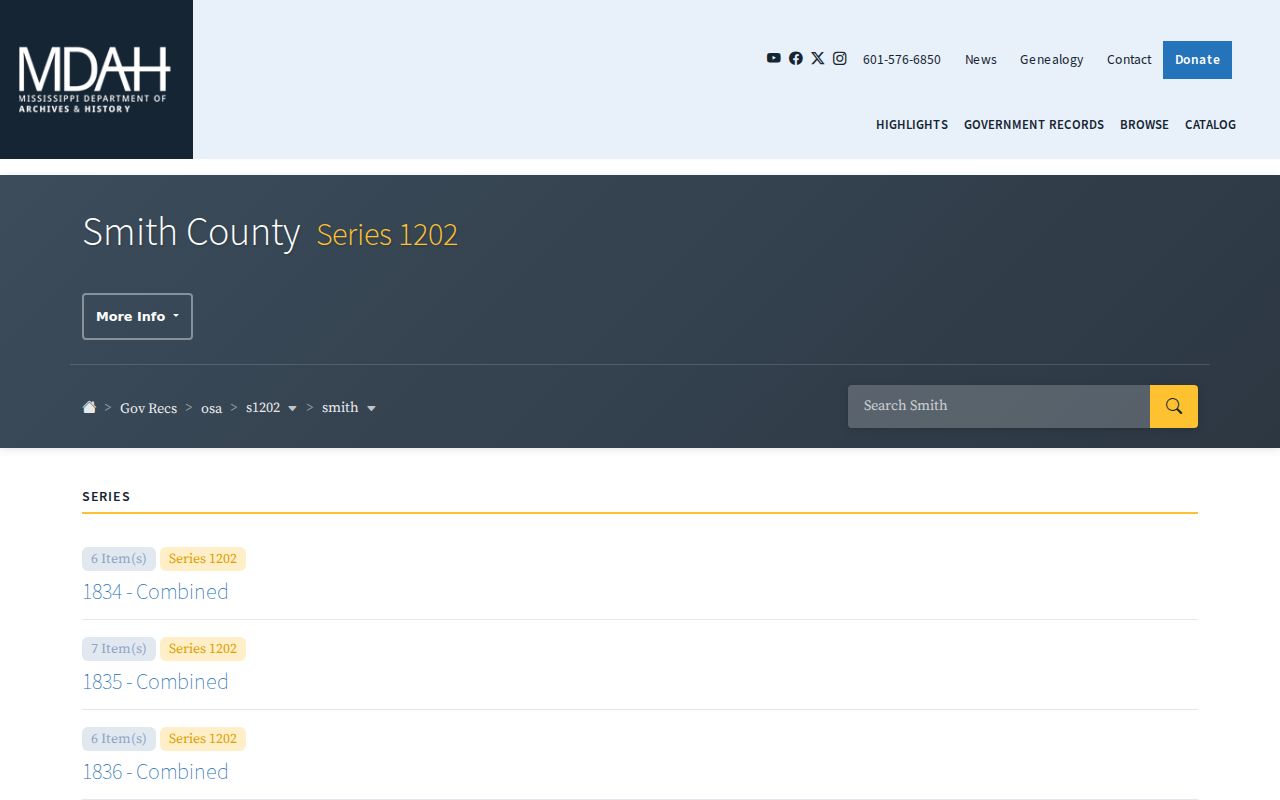
The catalog is a route into named historic assessment items, not a current valuation tool. Use it for archival context on Smith County parcels rather than present-day values.
Use Smith County Value Records Online and Offline
DCS prices full appraisal, property-tax, and deed-index access at $30 monthly or $330 annually. Researchers who skip the subscription can contact the Tax Assessor/Collector at 201 Courthouse Square in Raleigh, 601-782-9803, for assessment and parcel-location questions. Recorded conveyances come through the Chancery Clerk. Land records may be inspected from 8:00 a.m. to 5:00 p.m. weekdays. Public-made copies cost 25 cents per page. Staff-made copies run 50 cents, and certification adds an unstated fee. Mail requests need a reasonable document description, payment, and a stamped self-addressed envelope.
Know What a Smith County Property Value Cannot Tell You
A county property value exists for one purpose: tax administration. That number may differ from a later sale price. It may also differ from a private appraisal, a lender's analysis, or what a buyer thinks of a property's condition. None of those views is wrong. They simply answer different questions. The county does not publish a county-specific value trend. No fixed revaluation year can be read from a single parcel record. Treat any value you find in a deed or on the tax roll as a snapshot. It is not a forecast of what a parcel will fetch on the open market.
Value versus price. Smith County assessed value supports taxation; it is not a prediction of sale proceeds and is not a licensed appraisal.