
Documents Inside Smith County Deed Records
The Smith County Chancery Clerk keeps the official record for deeds, deeds of trust, direct and reverse indexes, sectional indexes, plats, judgments, tax-sale records, and certain UCC filings that place liens on real estate. Not every document in these Smith County deed records works the same way. A deed memorializes a transfer of ownership. A deed of trust or lien burdens the property instead. The parcel stays with its owner of record in that case.
| Deed Type | What It Does | Common Use |
|---|---|---|
| Warranty deed | Transfers the stated interest with title covenants | Ordinary purchase transaction |
| Quitclaim deed | Transfers only the interest the grantor may possess | Family conveyance or title cleanup |
| Trustee or executor deed | Conveys through a fiduciary role | Trust, estate, or authorized sale |
| Tax deed | Documents a transfer connected to tax-sale procedure | Delinquent-tax chain research |
| Deed of trust | Secures a debt against the real estate | Mortgage and release research |
A label on an instrument is only a starting point. Before deciding what a filing actually changed, read the parties, the legal description, the execution and filing dates, any references, reservations, and attached exhibits.
Search Fields in the Smith County Deed Index
The Deeds & Records Link lets visitors run Smith County deed searches by party, reference, date, and land description. Deeds date back to 1980 and deeds of trust to 2007, with fuller access available through a subscription.
| Index control | Use | Search caution |
|---|---|---|
| Grantor / Grantee and Partial Name | Find transfers by giving or receiving party | Repeat entity, estate, initial, and spelling variants |
| Book / Page or Instrument Number | Retrieve a known reference | Copy punctuation and leading characters exactly |
| Filing Date or Range | Narrow a known transaction period | Recording date may differ from execution or closing date |
| Subdivision / Lot / Block | Search platted property | Use the indexed subdivision name, not a neighborhood guess |
| Section / Township / Range | Search rural legal land | Try the ordering offered by the form |
Consult the official index shown below before choosing a field.
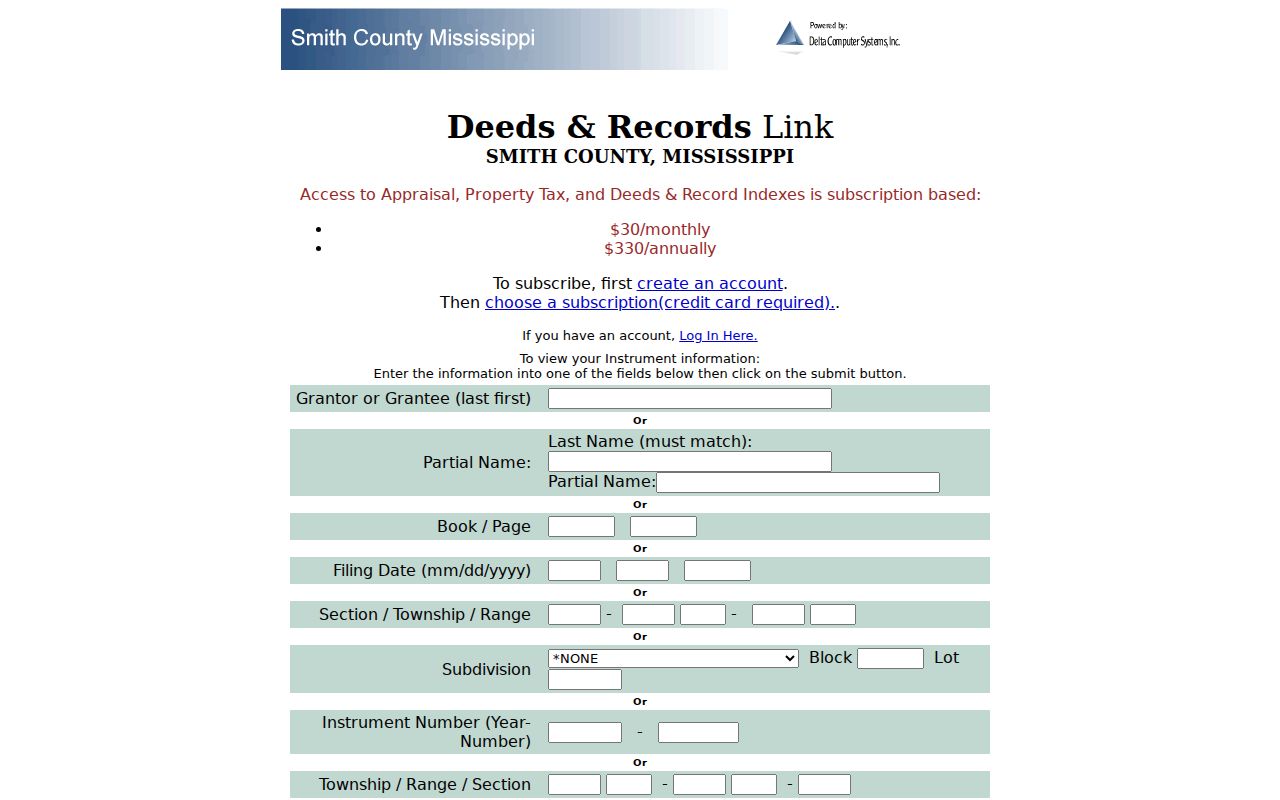
The county's official deed search screen offers its public query interface for Smith County property records. Detailed results and document images may still require a subscription or a request to the clerk.
Public Counter Access to Smith County Deeds
Land records stay open for inspection from 8 a.m. to 5 p.m. Monday through Friday at the Chancery Clerk, 201 Courthouse Square, Raleigh. Smith County's records FAQ lists the copy charges. Public-made copies cost 25 cents per page. Staff-made copies cost 50 cents per page. Confirm whether certification is available for the particular document before mailing payment.
Bring a focused request and the counter can move quickly. Give the grantor and grantee names, the approximate filing date, the instrument type, and the legal description. Also bring any book/page or instrument number you have. The office also serves as the essential fallback. An image may be illegible, an index entry misspelled, or an instrument may predate online coverage.
Note: Counter inspection is public. The vendor's fuller deed-index and image access still requires a subscription.
Walk the Smith County Grantor-Grantee Index
A title chain moves through roles rather than names. The current purchase deed lists the present buyer as grantee and the prior owner as grantor. Walk backward from there. Search that same grantor as a grantee in an earlier period, and the deed that put the land in their hands should surface. Repeat the step, era by era, checking that every instrument describes the same parcel. Legal descriptions, not surnames, keep the chain honest.
- Use the current assessed owner as a grantee and identify the newest plausible acquisition deed.
- Match its legal description, then copy the grantor exactly.
- Search that grantor as an earlier grantee and verify the same tract.
- Repeat until 1980, then continue in direct/reverse indexes, deed books, or microfilm.
- Grantor
- The party transferring the stated interest.
- Grantee
- The party receiving the stated interest.
- Chain of title
- The linked sequence of instruments affecting the same land.
- Book/Page and Instrument Number
- Two recorded-document reference styles used to retrieve an instrument.
Names alone won't carry the chain. One person may hold several parcels, and an estate or entity may show up under multiple indexed forms. The legal description is the thread that keeps two same-name Smith County transactions from being stitched together by mistake.
Before Smith County's 1980 Online Cutoff
The online portal reaches back only to 1980. Smith County's land-record history runs far deeper. Transfers before that cutoff stay offline. They live in deed books, direct and reverse indexes, microfilm, and courthouse archives. The Mississippi Department of Archives and History recommends starting with the courthouse originals. It also suggests leaning on state microfilm and county finding aids for older property records work.
Smith County finding aids cover original records from 1832 through 1966. The pre-1920 inventory lists Chancery Clerk abstract books. Selected digital assessment rolls can pinpoint a historic taxpayer or tract. Treat an assessment as a clue. It is no substitute for the recorded deed itself.
Note: Deeds of trust only go online from 2007. Mortgage history exits the portal earlier than deeds do.
The 1912 Courthouse and Today's Chancery Building
The MDAH landmark record dates the Smith County Courthouse to 1912 and notes its 1996 landmark designation plus a 2007 preservation easement. That is the historic building. Today's Chancery records and sessions sit in the newer Chancery Building across the square. A deed researcher who asks only for "the courthouse" may land at the wrong door.
This distinction matters most when you step from an online result to a book, plat cabinet, or certified deed copy. Put the clerk's current office address on a written request, not the historic-building label.
Mortgages, Releases, Liens, and Smith County Land
A deed chain shows who conveyed an interest in Smith County land. Encumbrance research asks a different question: what obligations or claims were recorded against it. Search deeds of trust by borrower or grantor name first. Then chase releases, satisfactions, cancellations, assignments, authorities to cancel, judgments, tax-sale entries, and real-estate UCC records tied to the parcel number.
The Mississippi State Tax Lien Registry is a separate state source. Match any state lien result to the exact person or entity and parcel evidence. Never assume it attaches to every similarly named Smith County owner of record. Quiet title, partition, and foreclosure disputes may pull you into Chancery records or registered PAMEC access.
Request a Smith County Deed Copy
Begin with the online reference and decide what you actually need. A working research copy may come from the vendor image or the clerk counter. A certified copy must come through the custodian. It should be requested by exact reference. Mail works when a counter visit is impractical. Before sending, confirm page count, certification, postage, and acceptable payment.
Recorded, not guaranteed. Smith County deed records show instruments accepted and indexed by the clerk. They are not a title opinion, and unrecorded interests or indexing errors can exist.
Keep the copy. A search log also helps, and a good one records the query, the date, and the party spelling used. It should note the legal-description match and the surrounding instruments checked too, because that log is what separates a retrieved deed from a full examination of title.