
Fields in Smith County Property Tax Records
Each year the Tax Assessor/Collector finds, classifies, and values taxable property, keeps the ownership maps, and helps owners file for homestead exemption. The same office presents the tax roll for approval, collects current tax, and advertises the yearly sale of land with unpaid real-estate tax. Delinquent payments and the records of tax sales and redemptions belong to the Chancery Clerk.
| Record item | What it means | Source |
|---|---|---|
| True value | The assessor's full-value estimate | Assessment roll |
| Assessed value | The statutory share used for taxation | Assessment roll |
| Exemption | Qualified relief applied to the account | Assessor |
| Current tax | Tax based on assessed value and millage | Collector |
| Sale or redemption | Later trail after delinquency | Chancery Clerk |
A name on the tax roll proves nothing about title. The land index often records a new deed before the tax roll catches up with the transfer.
Search Smith County Assessments by Exact Keys
The county's Property Link lets you query by owner name, address, parcel number, section, township, range, or PPIN. Its companion Property Appraisal search covers name, address, parcel, and PPIN. Full access to the appraisal data, property tax details, and deed index runs on subscription, at $30 a month or $330 a year.
| Key | Best use | Check |
|---|---|---|
| Parcel number | Match one tax account | Retain its exact format |
| PPIN | Use the portal's property key | Do not call it a legal description |
| Address | Find a current situs | Separate situs from mailing address |
| Owner | Find several holdings | Try name variants |
| Section/township/range | Identify rural land | Match every deed component |
A paywall is not a missing record. Take the search key and tax year to the county office by phone or in person.
Understand Smith County's Tax Formula
Under Mississippi DOR rules, Class I owner-occupied single-family real property carries an assessment at 10 percent of true value. Millage set by local bodies then applies to that assessed figure. A parcel's jurisdiction decides which county, town, school, and special-district charges stack onto the bill.
- True value
- The assessor's estimate of full value.
- Assessed value
- The statutory tax base.
- Millage
- The local rate applied to assessed value.
- Homestead exemption
- Relief for a qualifying primary residence.
- Tax lien
- A claim arising from unpaid tax.
A year-to-year swing can trace back to value, classification, exemption, or millage. Keep those fields apart when reading Smith County property tax records.
Follow a Smith County Tax Account Step by Step
Trace the parcel through every responsible office, using the same parcel key and tax year at each step.
- Match the address, parcel, PPIN, owner, and legal-description clues in Property Link.
- Note true value, assessed value, classification, and exemptions on the annual roll.
- Call the Tax Assessor/Collector at 601-782-9803 to confirm current tax, parcel location, or payment.
- For delinquent tax, contact the Chancery Clerk, as the county directs those payments there.
- Compare any sale or redemption trail with the latest deed before making a title decision.
For current taxes, the county FAQ lists cash, check, cashier's check, money order, and credit card. When you confirm a payoff, ask the office for the effective date.
Use the Smith County Homestead Window
Mississippi opens the homestead application window on January 1 and closes it April 1. The Tax Assessor/Collector helps local applicants file. Never assume an exemption held by a former owner survives the transfer. Bring the parcel identity and whatever proof the office requests. DOR guidance covers ownership, occupancy, marital status, purchase details, vehicles, and age or disability where a category demands them. Fix any mismatch between the roll and the deed before the window shuts.
Note: Confirm the current year's proof and exemption category directly with the Smith County Tax Assessor/Collector.
Appeal a Smith County Assessment on Time
Start with the assessor, who can walk through parcel data and correct plain factual errors. A formal objection runs on the Board of Supervisors calendar instead. DOR guidance sets the appeal deadline for the county roll at the first Monday in August, though the official notice for that year controls.
Protect the deadline. Review the open roll, raise errors with the assessor, and file the required written objection by the published date.
Match the evidence to the claimed error. A deed settles ownership; a survey or legal description settles acreage; photographs show condition; comparable facts speak to value. Keep a copy of everything filed, along with the parcel number.
Separate Current, Delinquent, and Forfeited Tax Records
The Tax Collector runs the current account and the annual sale notice. Sale and redemption papers sit with the Chancery Clerk. The Secretary of State keeps its own tax-forfeited-land search. You can search it by county, address, parcel, PPIN, owner, value, legal description, survey location, and auction fields. None of these lists substitutes for another. A state match is a lead, nothing more. Redemption status, later filings, and the exact legal description all need checking. For the value fields, the Smith County property value guide explains what they mean.
Historic Smith County Tax Evidence at MDAH
MDAH finding aids hold an 1851 delinquency account. They also hold tax-levy certifications dated 1853, 1858, and 1859, plus 1880 orders raising assessments for named owners. These are countywide records. Tie one to a town only after matching the legal description. The digital assessment catalog covers combined assessments for 1834 through 1841. It adds selected land years from 1842 through 1889. The run has gaps.
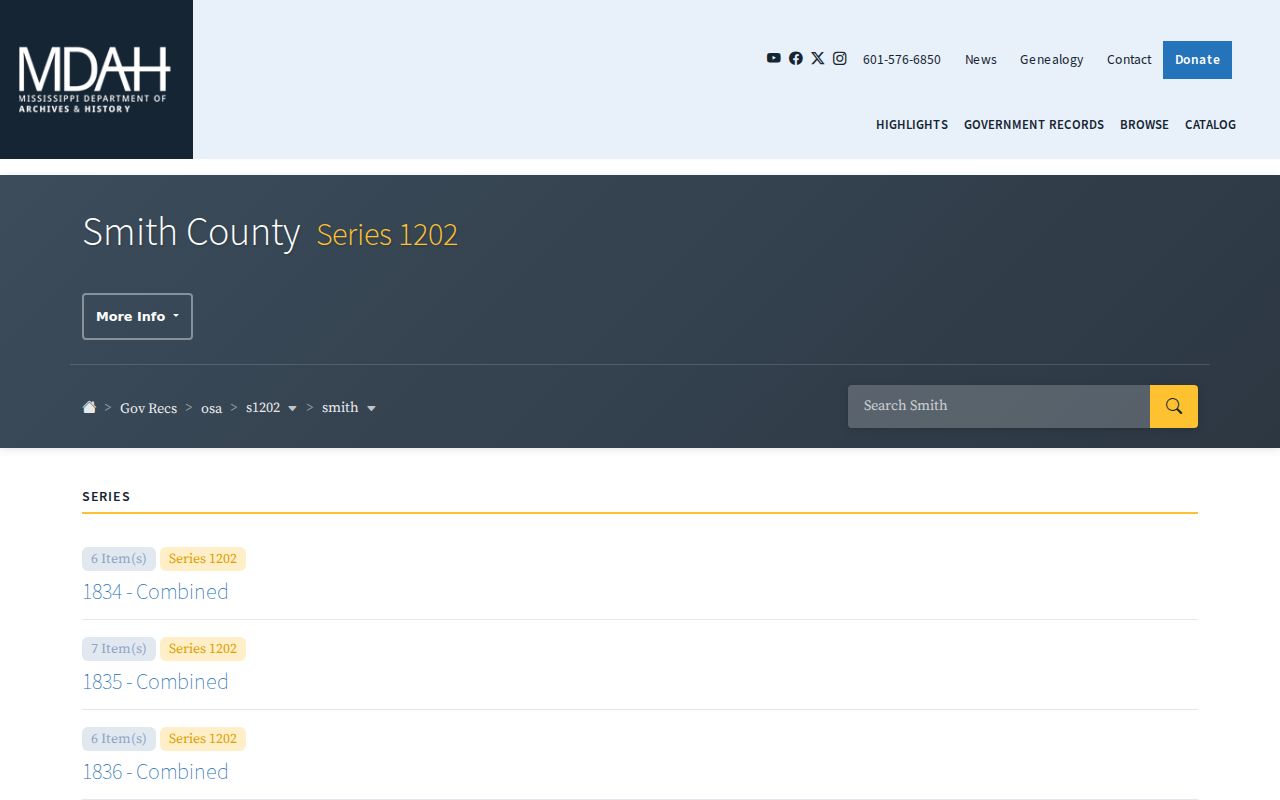
The gaps point researchers to courthouse inventories and microfilm rather than guessed values.
Reach Smith County Tax Records Offline
Need the roll, ownership map, parcel location, exemption, or current tax? Call or visit the Tax Assessor/Collector. The Chanc Clerk is the office for delinquency, sale, redemption, and related land records. Land-record inspection runs weekdays from 8:00 a.m. to 5:00 p.m. A mail-copy route exists too. Public-made copies run 25 cents a page. Staff-made copies are 50 cents, with certification billed separately. Any identifiable nonexempt record can also be requested under the Mississippi Public Records Act. Costs cover actual search, review, copy, and mailing.
Know What Smith County Property Tax Cannot Prove
No tax bill fixes a boundary, quotes today's market price, or clears a title. The roll answers tax administration questions. The Chancery deed index answers recorded transfers. A surveyor settles the physical line. Mortgages, judgments, estates, corrective deeds, and redemptions each live in separate records, and keeping those sources divided keeps each answer tied to the question it was built for.
Verify Smith County Property Tax Records at the Counter
Bring specifics to the counter. A request that names the parcel gets answered faster. Staff can pull the right account when you give them the parcel number or PPIN, the owner's spelling, the situs address, and the tax year. Say what you need, too. A valuation question calls for the assessment-roll entry. Ask which facts the assessor used to classify the land and improvements. A payment question calls for the current balance. Get the date through which that balance is valid. Delinquency, sale, and redemption matters move to the Chancery Clerk, and the same identifiers let the second office follow the same tract.
Keep every copy from every stage. A tax receipt proves the payment it shows, and a roll entry reports only the assessment for its year. A sale notice marks one step in a statutory process, so read the documents in date order before treating an old notice as the parcel's present condition.
Match Smith County Tax Data to the Recorded Land
Legal descriptions come in two flavors in Smith County. Rural tracts are described by section, township, and range. Platted lots run by subdivision, lot, and block. The tax portal's search keys can locate an account, but the deed's legal description is what bridges the result to the land index. When two results share a similar owner name or mailing address, compare acreage, survey references, and adjoining-owner clues before choosing.
A mailing city proves little about jurisdiction. A postal town name can cover land outside municipal limits. Every county office uses a Raleigh mailing address. Municipal millage should follow the parcel's actual jurisdiction, never a ZIP label. If the account and deed disagree, ask for help. The assessor can identify the mapped parcel, and Chancery staff can locate the controlling recorded description.