
Build a Smith County Previous-Owner Timeline
Anchor the timeline in a confirmed current deed, then add one transfer per row from there. Smith County's online deed index reaches back to 1980. Past that cutoff the trail shifts. The Chancery Clerk's older indexes and books, along with Mississippi Department of Archives and History holdings, become the working sources for earlier owners.
| Source | Years It Covers | Where Held | What It Shows |
|---|---|---|---|
| DCS Deeds & Records Link | 1980 forward for deeds | Subscription portal | Grantor, grantee, date, instrument, book/page, and land-description search |
| Deed books and direct/reverse indexes | Earlier than the online run | Smith County Chancery Clerk | Prior transfers tied to names and legal descriptions |
| Plats and sectional indexes | Varies by record | Chancery Clerk | Lot, block, subdivision, and rural land context |
| MDAH records and microfilm | Smith County material from 1832 through 1966 | State archives | Historic records, tax clues, and copies of selected county runs |
The official DCS deed-search form is the natural starting point for the chain. Its grantor, grantee, land-description, date, and book fields show who passed each parcel to whom.
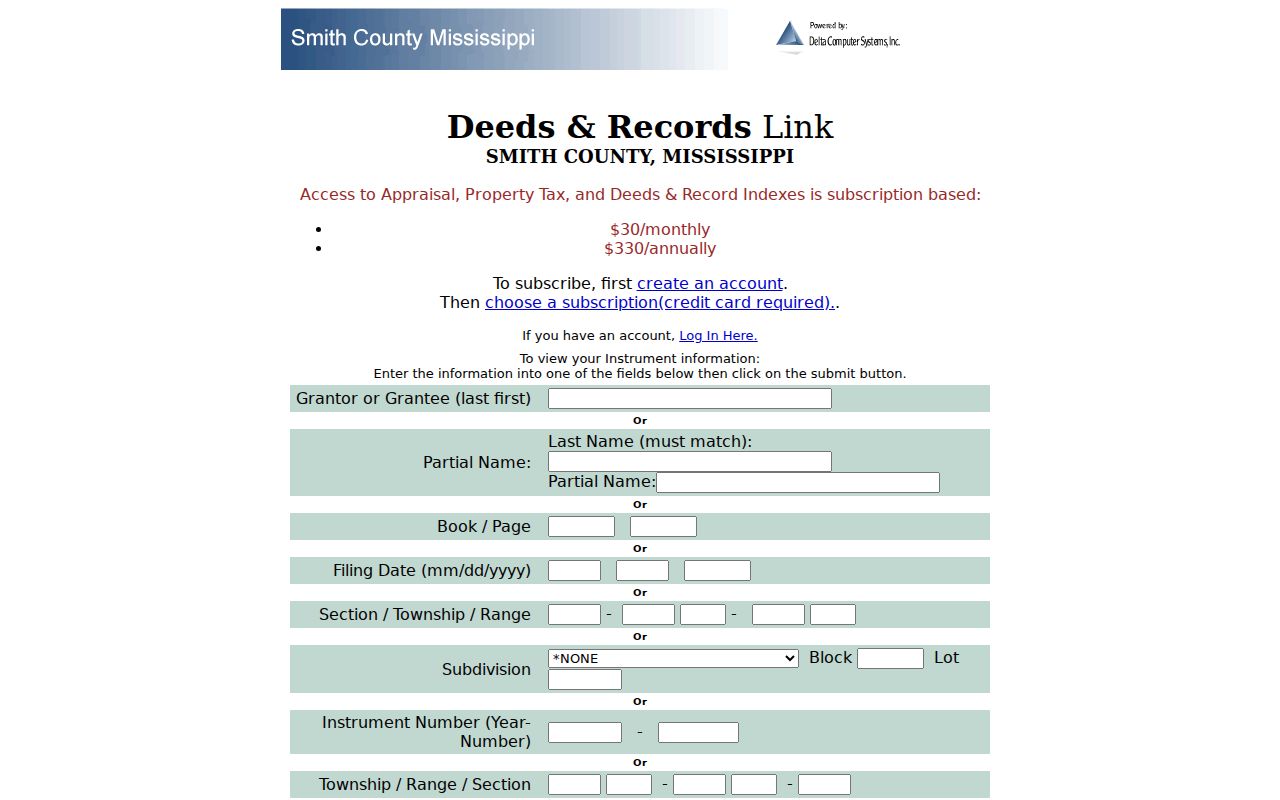
Log every transfer the same way. Record the date, grantor to grantee, deed type, and book and page so similar names never merge into one chain.
Walk the Smith County Deed Chain Backward
The Smith County deed index takes many keys. Grantor or grantee names, partial names, book and page, filing dates, instrument numbers, subdivision with lot or block, and legal land descriptions all work. When a surname is common, combine several keys at once.
- Find the current owner's acquisition deed by searching that person or entity as grantee.
- Read the grantor, legal description, filing date, deed type, and book/page from that instrument.
- Search that grantor as a grantee and match the same land description.
- Repeat until the online run ends, then continue in the direct and reverse book indexes at the clerk's office.
- Grantor and grantee
- The conveying party and receiving party named in an instrument.
- Chain of title
- The ordered series of instruments through which ownership passed.
- Reverse index
- An index organized from the receiving party's side of the transaction.
- Quitclaim and warranty deed
- Different conveyance forms whose legal effect must be read from the actual instrument.
Match Smith County Prior Owners by Land
Matching two deeds by surname alone never proves they concern the same tract. Compare the land instead. Subdivision, lot and block, section-township-range, acreage, adjoining-owner calls, and book and page references should line up. Check each element one by one. Rural Smith County deeds may lean on federal land-survey parts. A platted parcel may carry a subdivision name that later picked up spelling variants. Read legal descriptions closely.
A street address is a modern finding aid only. Old deeds often omit it, and a postal city can differ from municipal geography. Keep the legal description at the center of the former-owner chain.
Use Every Smith County Access Channel
Online results require a DCS subscription, priced at $30 monthly or $330 annually. The public counter offers another route. Smith County land records are open for inspection from 8:00 a.m. to 5:00 p.m., Monday through Friday. Copies run 25 cents per page when the public makes them. Staff-made copies cost 50 cents per page, with any certification fee added separately.
Mail requests work too. Identify the document reasonably. Enclose a check or money order payable to the Smith County Chancery Clerk, and add a stamped self-addressed envelope. The office sits at 201 Courthouse Square in Raleigh. Chancery records are kept in the new building across from the 1912 courthouse.
Bridge Gaps in a Smith County Ownership Chain
A neat sequence of warranty deeds rarely survives untouched. Estate settlements, court decrees, tax sales, parcel splits, and name variations all interrupt the chain. The Chancery Clerk also holds Chancery Court and tax-sale records. Search those record families whenever a prior owner seems to vanish. A deed of trust is not itself a transfer of ownership. DCS states its deed-of-trust coverage online begins in 2007.
Check timing at the counter. The county records documents and makes them available for public viewing the day they arrive. The assessment roll, though, can lag a new conveyance.
Read Historic Smith County Assessment Clues Carefully
MDAH's digital assessment Series 1202 covers selected Smith County land assessments from 1842 through 1889, not an unbroken annual roll. Its county inventory also lists an 1851 delinquency account and 1880 orders raising named real-estate assessments. These sources help date a person's tie to land. They can support a prior-owner hypothesis. They still do not replace a deed.
The Raleigh Library adds a local route. Genealogy publications, Ancestry access, and a microfilm reader and printer are available there. Use such sources to explain people and places, then return to recorded instruments for the true ownership sequence.
Know How Far Smith County Previous-Owner Records Reach
Smith County was formed in 1833. MDAH describes surviving original-record material spanning 1832 through 1966. That broad archival span does not mean every deed is digitized. Nor does it mean every year is complete. Once the online index ends, ask the Chancery Clerk for help. Request the relevant direct, reverse, sectional, deed-book, and plat series. Then compare the courthouse run against MDAH microfilm and finding aids.
Online cutoff. DCS deed coverage begins in 1980; earlier previous owners require the clerk's books, indexes, plats, or archive copies.