
Start a Smith County Search
A Smith County property search works best when it moves from a loose clue to a firm land key. The Smith County Property Link accepts an owner name, number and street, parcel number, PPIN, or section, township, and range. For a house, an address is the easiest way in. Rural parcels are different. Postal names change there, so a parcel number or legal description works better.
Owner lookups take care too. An estate, a trust, or a company can hold title instead of a person. Treat online results as discovery only. A tax roll is not guaranteed title. An ownership map is not a survey. Match the legal description across the assessor record and the latest deed before calling two entries the same land.
- Search Property Link by address and copy the parcel number, PPIN, indexed owner spelling, and legal description.
- Use the owner and land description in the Chancery Clerk deed index. Match the land, not just the street.
- Check assessor value and exemption fields, then ask the Tax Collector about the current bill or delinquency.
- Request the assessor ownership map and compare it with the recorded plat or deed description.
- Order the instrument from the custodian when a certified or legally important copy is needed.
Smith County Records Custodians
No single counter in Smith County holds every land fact. Deeds, plats, deeds of trust, judgments, tax-sale records, and certain real-estate UCC instruments all sit with the Chancery Clerk. The Tax Assessor/Collector builds the annual roll, maintains the current ownership maps, handles homestead claims, collects current taxes, and advertises the annual sale. The Circuit Clerk keeps Circuit and County Court records instead, not the deed books. Knowing which office holds what saves a trip.
Smith County Search Fields
The Delta landing form serves both town lots and rural tracts. Names follow a last-first convention. Addresses are split into number and street. Separate boxes are given for Parcel Number and PPIN. Section, township, and range give rural tracts a legal route in. The public form does not state a required field. There is no stated parcel format, result cap, or any city or ZIP filter.
| Field | Best use | Caution |
|---|---|---|
| Name | Assessed parcels | Try estates, trusts, initials, and exact company names |
| Address | Known site | Mailing and situs addresses may differ |
| Parcel or PPIN | Tax-record bridge | Copy the displayed format exactly |
| Section, township, range | Rural tract | Keep the portal's order |
A failed form search does not mean the parcel is missing. Shorten the street, change the name form, or call the assessor with the legal description in hand.
Smith County Access Channels
Full appraisal, property-tax, and deed-index access runs through Delta by subscription. The cost is $30 monthly or $330 annually. Counter access works differently. Smith County opens its land records for inspection on weekdays. Hours run 8 a.m. to 5 p.m. Public-made copies cost 25 cents per page, staff-made copies 50 cents, with certification priced extra. Mail requests should name the parties, the book and page or instrument number, and the land description. Enclose payment and a stamped return envelope. Older records lead to the Mississippi Department of Archives and History. That agency holds county microfilm, boxed originals, and digital assessment catalogs. These routes complement one another rather than compete.
Smith County Land Record Types
Every Smith County property record answers a narrow question. Deeds document transfers. The assessor roll ties an owner field and a value to a tax parcel. Tax records show annual charges and collection status. Plats supply the recorded subdivision context. Court and lien files can reveal disputes or burdens a parcel card never mentions.
| Record Type | What It Documents | Kept By | Access |
|---|---|---|---|
| Deeds | Transfers and legal descriptions | Chancery Clerk | Subscription index, counter, mail |
| Mortgages and liens | Secured interests and releases | Chancery Clerk and courts | Index, books, court files |
| Tax and assessment | Value, class, exemption, tax status | Assessor and Collector | Subscription portal or office |
| Plats and parcels | Lot context and parcel location | Chancery Clerk and Assessor | Plat cabinet and ownership map |
| Estate and land cases | Probate transfer, partition, quiet title | Chancery Court | Counter or PAMEC where available |
A parcel number is an administrative key, not a deed description. A plat is a recorded drawing of lots, streets, and easements. In the deed index, a grantor gives an interest and a grantee receives one. Those links carry a search from the present roll. They lead back to the record that created the ownership entry.
Smith County Deed Time Depth
The online index lists deeds back to 1980 and deeds of trust to 2007, but those are vendor access cutoffs, not the start of county land records. Earlier owners must be traced through direct and reverse indexes, deed books, plat cabinets, and microfilm at the Chancery Clerk or MDAH. Keep the details for every transfer: grantor, grantee, filing date, book and page or instrument number, and the full legal description. When the web chain ends, carry the same names and land calls into the older books. A street address often fails across decades.
Older Smith County property records continue in courthouse books and archive holdings beyond the online cutoff.
Smith County Parcel Map Gap
Smith County publishes no official interactive GIS parcel viewer. Its FAQ instead points anyone seeking a parcel's location to the Tax Assessor/Collector. The assessor keeps the current ownership maps. The Chancery Clerk holds plats and recorded land descriptions. A statewide municipal-boundary layer can add town-limit context. But it is no tax parcel layer and cannot prove ownership, acreage, easements, or a fence. Give the assessor the address, parcel number, PPIN, and legal description. Then compare the ownership map against the deed and any subdivision plat.
Smith County Values and Taxes
Each year the Smith County assessor finds, classifies, and values taxable property across the county. Mississippi's formula starts with true value. A class ratio and then millage are applied to that figure, with owner-occupied Class I single-family land generally at 10 percent and most other real property at 15 percent. Exemptions can shift the taxable amount. Current taxes go to the Tax Collector. Delinquent payments and redemption records sit with the Chancery Clerk, which advertises and holds an annual tax sale each year. The state tax-forfeited land search covers parcels certified to the state, but a sale notice is never proof of clear title.
Historic Smith County Assessments
Smith County formed in 1833. The MDAH finding aid reaches back further, opening with records from 1832. Its holdings include an 1851 delinquency account, tax-levy certifications from the 1850s, 1880 orders raising named land assessments, and 1900 tax receipts. These papers predate the modern tax roll. The MDAH assessment catalog lists combined assessments for 1834 through 1841 plus selected land years through 1889, adding value and ownership clues.
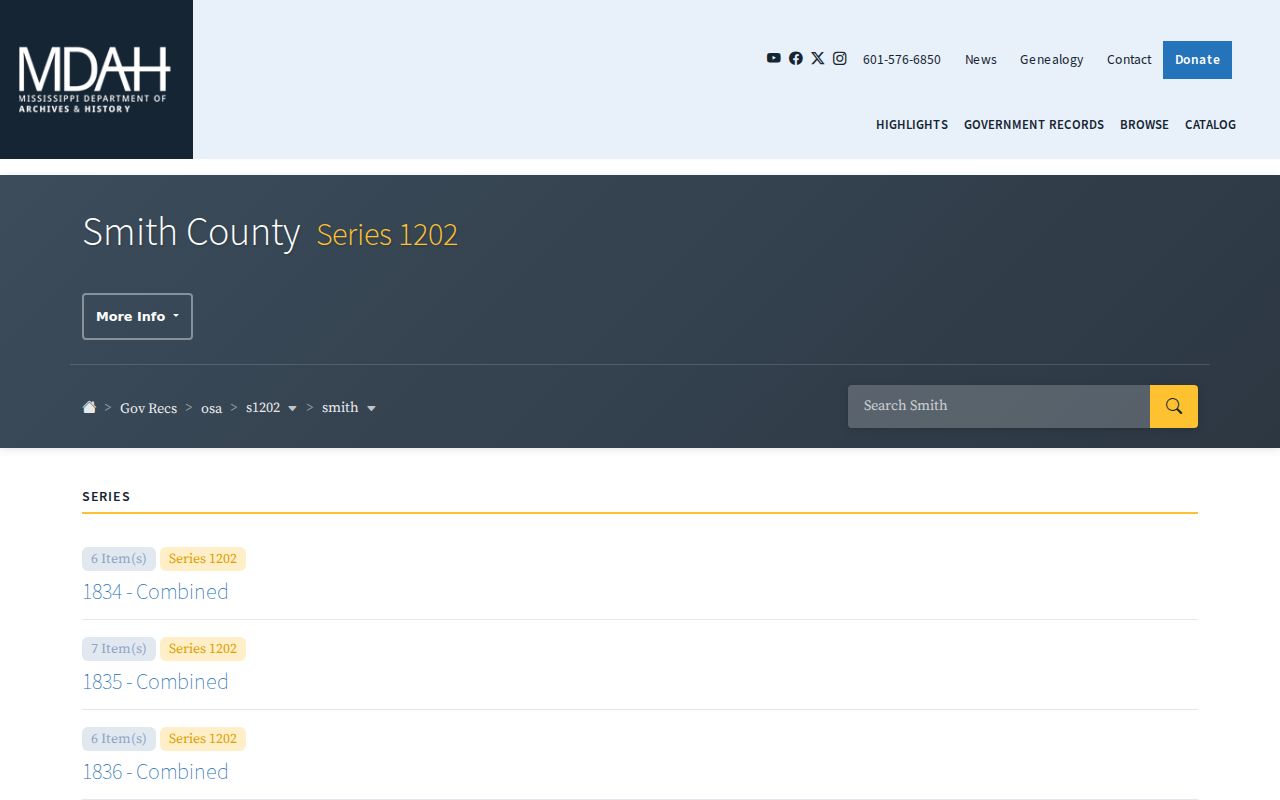
This MDAH catalog page lists selected years, not a continuous annual series. Never fill its gaps by assumption.
Raleigh Records Across the Square
The 1912 Smith County Courthouse holds Mississippi Landmark status. Its designation was recorded in 1996. A 2007 preservation easement runs through 2032. Current Chancery records and sessions, however, are kept in a newer building across from the courthouse. Ask only for the courthouse and you may reach the landmark while the deed counter sits elsewhere, so the MDAH courthouse entry documenting the building's history is worth a look before you go.
The landmark record supplies history. The Chancery office page supplies current land-record access.
Smith County Estate Land Trails
Land can pass through probate without a normal sale. A Chancery estate file may hold a will, petition, inventory, authority to sell, administrator's deed, heirship facts, and closing order. Search the decedent in the estate docket. Then follow the representative, heirs, and buyer through the land index. Mississippi birth certificates stay restricted for 100 years and death certificates for 50, subject to qualified-applicant rules. Cemetery entries and obituaries help. They cannot transfer land, though. Read the probate order beside the recorded deed and compare both legal descriptions.
Local Smith County Research
The Smith County Genealogical Society and Raleigh Library help. Their genealogy computer offers Ancestry access, plus a microfilm reader and printer, marriage and obituary projects, family histories, and a cemetery project intended to cover 181 cemeteries. MDAH adds another thread. It catalogs the indexed, two-volume, 431-page Smith County, Mississippi, and its Families: 1883-2003. A former owner, estate, or rural place name can lead straight to a deed-book search. Mine these sources for name variants. The Chancery index then holds the recorded land trail.
Smith County Public Access Rules
The Mississippi Public Records Act of 1983, Miss. Code Ann. sections 25-61-1 and following, supports access to nonexempt records. Response times differ. A public body with a policy generally has seven working days to respond. One without a policy generally has just one working day. Fourteen working days is the general production ceiling unless agreed. Charges are limited to actual reasonable costs for search, review, copying, and mailing. Inspection itself carries no copy charge. Sealed, privileged, confidential, and protected-address material remains restricted. A strong request names the existing record. It also gives the date span and the parcel, instrument, or case number.
Limits of Smith County Records
Smith County property records can identify assessed ownership, recorded transfers, tax values, liens, plats, and some court events. They cannot prove all interests are clear. A tax-roll owner may lag a new deed. Index lines can omit terms. The instrument image may say more, a tax map is not a survey, and assessed value is never a sale appraisal.
Lawful use. Use records for due diligence, title history, estate work, boundary questions, and civic research. Never use owner details to stalk, harass, or harm anyone.
Get the instrument itself. The Chancery Clerk issues it, and a title professional should weigh in whenever the stakes are real. A licensed surveyor settles a contested boundary. Verify current taxes with the Collector and parcel location with the Assessor rather than trusting a third-party display.